Key Takeaways:- The average drug takes 10–15 years and $1.3–2.6 billion to reach patients — but the bottleneck isn't the science, it's the manual data review that sits between trial completion and database lock.
- Tufts CSDD's 2024 research puts the cost of a single delay day at approximately $500,000 in unrealized prescription sales and $40,000 in direct trial costs — every day saved is a day a patient waits less.
- Database lock cycle times have increased 32% since 2017 for large pharma, with LPLV-to-DBL stretching from weeks to months because data review is still a manual relic.
- AI-native clinical data review compresses data cleaning, reconciliation, and anomaly detection from months to days — achieving 99.9% accuracy with audit-ready traceability.
- FDA expedited pathways (Fast Track, Breakthrough Therapy, Priority Review, Accelerated Approval) shorten regulatory review — but none of them touch the data review bottleneck that precedes submission.
Executive Summary
The pharmaceutical industry has spent two decades optimizing everything around the drug approval process — target discovery, adaptive trial designs, biomarker-driven enrollment, FDA expedited pathways. Yet trial timelines haven't improved. The reason is staring every clinical operations leader in the face: the bottleneck is review, not science.
Between Last Patient Last Visit (LPLV) and database lock sits a manual data review process that consumes weeks to months of human pattern-matching. Data managers scroll through SDTM datasets, reconcile lab data against vendor reports, chase down discrepancy patterns, and issue queries one at a time. This is the same workflow that existed 20 years ago — and it's why Tufts CSDD's 2024 data shows a 32% increase in LPLV-to-database-lock cycle times for large pharma since 2017. While every other function in drug development has been reengineered, clinical data review remains a spreadsheet-and-eyeball exercise.
The cost isn't measured in reviewer hours. It's measured in patient days. Tufts CSDD's October 2023 study — the first rigorous empirical update in 30 years — found that a single day of delayed market entry costs approximately $500,000 in unrealized prescription sales, plus $40,000 in direct daily clinical trial costs. For a drug addressing a serious condition with unmet medical need, that's not just money. It's a day a patient waits without the therapy they need. Data review is not a human job anymore. The faster drug approval process doesn't run through FDA review — it runs through the data review pipeline that precedes it.
Why the Drug Approval Process Is Stuck
To understand where the drug approval process breaks down, you have to look at the full pipeline. Drug development follows a structured path: discovery, preclinical research, IND application, Phase 1–3 clinical trials, NDA/BLA submission, FDA review, and post-market surveillance. The entire journey takes 10–15 years and costs $1.3–2.6 billion, with only 7–12% of drugs that enter clinical trials ultimately receiving approval.
Every stage has been optimized. AI-driven drug discovery platforms have reduced early discovery timelines by 30–50%. Adaptive trial designs cut Phase 2 failures. The FDA created four expedited pathways — Fast Track, Breakthrough Therapy, Accelerated Approval, and Priority Review — to shorten regulatory review for serious conditions. Priority Review alone cuts FDA review from 10 months to 6. Breakthrough Therapy designation adds intensive FDA guidance throughout development.
But here's what nobody talks about: none of these optimizations touch the data review bottleneck.
| Drug Development Stage | Average Timeline | Optimization Status |
|---|
| Discovery & Target Identification | 2–4 years | AI-driven, 30–50% faster |
| Preclinical Development | 1–3 years | Optimized with ADME/tox automation |
| Phase 1–3 Clinical Trials | 4–8 years | Adaptive designs, decentralized trials |
| Clinical Data Review & DB Lock | Weeks to months | Manual. Unchanged in 20 years. |
| FDA Review (NDA/BLA) | 6–10 months | Expedited pathways available |
| Post-Market Surveillance | Ongoing | Real-world evidence integration |
Discovery got faster. Preclinical got faster. FDA review got faster. The data review pipeline between trial completion and submission? It got slower. Tufts CSDD and eClinical Solutions found that since 2017, large pharmaceutical companies experienced a 32% increase in the LPLV-to-database-lock cycle time. Overall cycle times increased by six days over just two years for companies using five or more data sources. More data sources, more complexity, same manual review process — and the timeline stretches.
The $500,000 Day: What Delay Actually Costs
For 30 years, the industry cited a single number for the cost of a delay day: $4–5 million, based on 1993 estimates from the Office of Technology Assessment and the Boston Consulting Group. That figure was calculated by dividing the expected annual revenue of a 1990s-era blockbuster drug by 365 days. It was anecdotal, outdated, and wildly imprecise.
In October 2023, Tufts CSDD conducted the first rigorous empirical study on delay costs, analyzing 645 drugs launched since January 1, 2000. The results, published in 2024 in Therapeutic Innovation & Regulatory Science, replaced the old folklore with real data:
- ~$500,000 per day in unrealized prescription drug or biologic sales (average across all therapeutic areas)
- ~$40,000 per day in direct clinical trial costs (the cost of keeping the trial apparatus running)
- Oncology and CNS drugs — representing 55% of the dataset — showed significant variation, with oncology delay costs running higher given narrower patient populations and premium pricing
"The financial value of time is an essential measure used by drug development professionals to inform budget and resource planning as well as investment decisions. The two figures — the value of a day in delayed or lost prescription sales, and the direct daily costs to conduct a clinical trial — are frequently and widely cited. However, they often rely on antiquated and inaccurate estimates that were introduced more than 30 years ago."
— Tufts Center for the Study of Drug Development, 2024
But the financial number is only half the story. For patients with serious conditions and unmet medical need — the exact populations that Fast Track and Breakthrough Therapy designations exist to serve — a delay day isn't a line item. It's a day without treatment. It's a day of disease progression. It's a day a family waits. Every day saved is a day a patient waits less. That's not a marketing slogan. It's the ethical frame for why data review automation isn't optional — it's a moral imperative.
The Hidden Bottleneck: What Happens Between LPLV and Database Lock
Database lock is the gate between clinical trial execution and statistical analysis. At DBL, all trial data has been collected, cleaned, reconciled, and validated. No further edits are permitted without exceptional oversight. It's the moment the data is frozen for submission.
What happens between LPLV and DBL is where timelines die. The process looks like this:
- SDTM dataset review — Data managers manually review standardized datasets for conformance, missing values, and logical consistency across domains (DM, AE, LB, VS, CM, etc.).
- Reconciliation — Lab data is reconciled against central lab reports. SAE forms are reconciled against safety databases. Vendor data is reconciled against EDC entries. Third-party data sources are cross-checked.
- Edit check validation — Manual edit checks are run, reviewed, and adjudicated. Discrepancies are flagged, queries are issued, and responses are tracked.
- Anomaly detection — Reviewers scan for outliers, unexpected patterns, and data quality signals that automated checks didn't catch. This is human pattern-matching at industrial scale.
- Query management — Open queries are resolved. Site responses are reviewed. Repeated queries are escalated. The query backlog is the single biggest contributor to DBL delay.
- Medical review — Medical coders and physicians review safety signals, adverse event narratives, and protocol deviations for clinical significance.
- Database lock readiness — Final QC, sign-off from all stakeholders, and formal lock.
Each step is sequential, manual, and dependent on human availability. A single reviewer bottleneck — a data manager on vacation, a medical coder with a backlog — cascades into weeks of delay. And because data review happens at the end of the trial, every problem discovered late has been compounding since the first patient enrolled.
| Manual Data Review Task | Manual Timeline | AI-Native Timeline | Time Compression |
|---|
| SDTM dataset review (all domains) | 2–4 weeks | Hours | ~95% |
| Lab & vendor reconciliation | 1–3 weeks | 1–2 days | ~90% |
| Edit check validation & query generation | 2–3 weeks | 1 day | ~95% |
| Anomaly detection across datasets | 1–2 weeks | Hours | ~95% |
| Query resolution tracking | Ongoing (weeks) | Real-time | Continuous |
| Total LPLV to DBL | 6–14 weeks | 3–7 days | ~85% |
How AI Replaces Manual Review and Accelerates the Approval Process
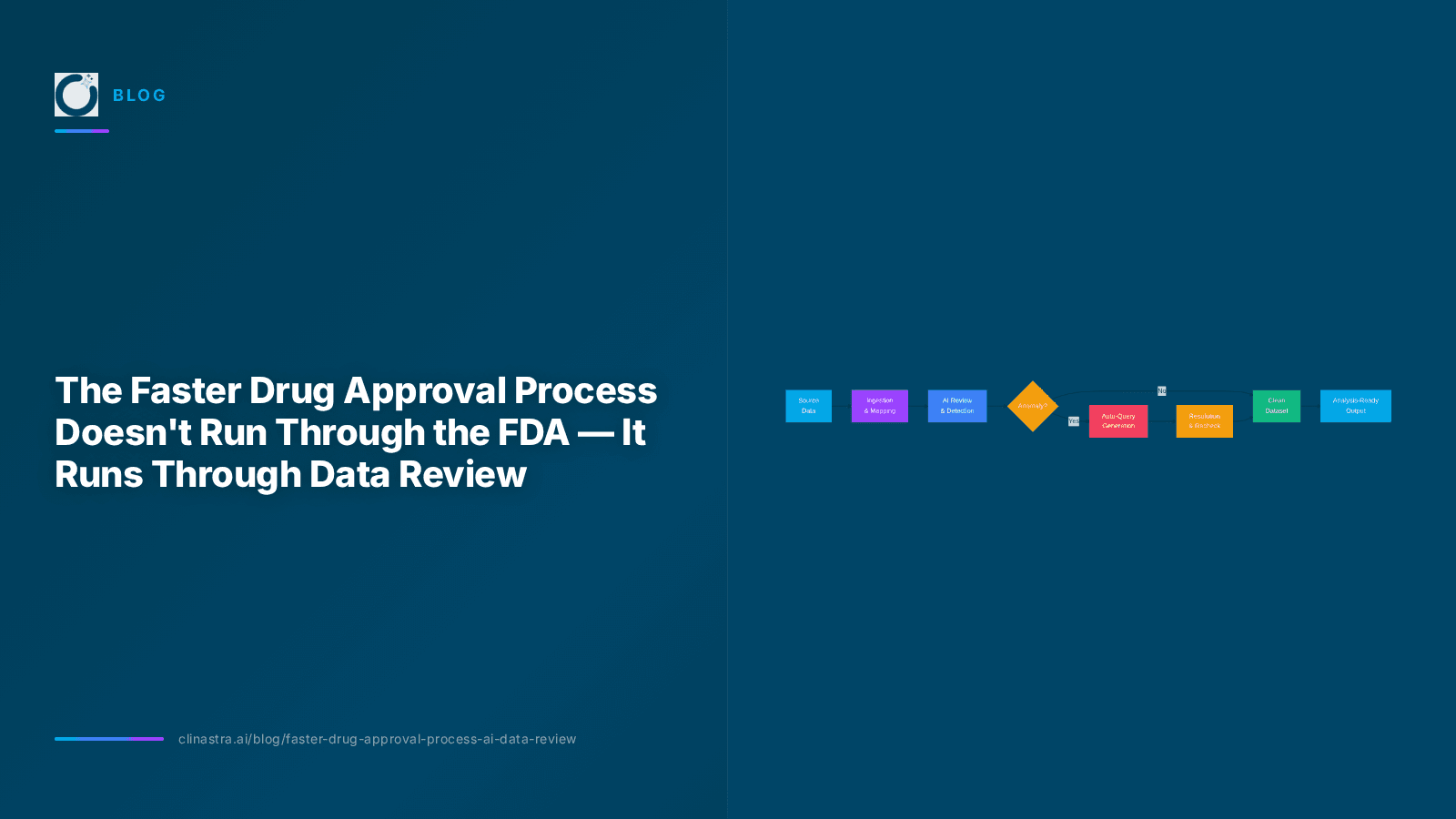
The faster drug approval process doesn't require a new regulatory pathway. It requires replacing the manual review pipeline with AI-native clinical data review. Here's how it works:
1. Continuous Data Review Throughout the Trial
Manual review waits until the end. AI reviews data as it arrives. ClinAstra ingests SDTM and ADaM datasets in real time, running anomaly detection, reconciliation checks, and edit validation continuously from the first patient enrolled. By the time LPLV arrives, the data is already clean. Database lock shifts from a weeks-long sprint to a days-long confirmation.
2. Automated Reconciliation Across All Data Sources
Lab reconciliation, SAE reconciliation, vendor reconciliation, third-party data reconciliation — all run automatically. Discrepancies are flagged with full traceability: the source dataset, the matched record, the discrepancy type, and the recommended action. No black boxes. Every flag is audit-ready by design.
3. AI-Driven Anomaly Detection at 99.9% Accuracy
Where human reviewers scan for outliers one domain at a time, ClinAstra's AI models detect anomalies across all domains simultaneously — identifying patterns that are invisible to manual review. Statistical outliers, logical inconsistencies, cross-domain discrepancies, and safety signals are flagged in hours, not weeks. The accuracy rate isn't aspirational — it's measured, validated, and traceable.
4. Intelligent Query Generation and Management
Queries aren't just flagged — they're generated with context. ClinAstra produces queries that include the data point, the discrepancy explanation, and the evidence trail. Site coordinators receive actionable queries instead of generic flags. Resolution cycles compress from weeks to days.
5. Audit-Ready Traceability for Regulatory Submission
Every flag, every query, every anomaly detection event is logged with a complete audit trail. When the FDA asks "how was this data reviewed?" the answer isn't "our team checked it." The answer is a traceable, timestamped record of every AI-driven review action. That's not just faster — it's audit-ready by design.
Step-by-Step: Accelerating Your Drug Approval Process with AI Data Review
- Audit your current LPLV-to-DBL cycle time. Pull the last three trials. Measure the actual days from LPLV to database lock. Break it down by review task: SDTM review, reconciliation, edit checks, query resolution, medical review. You'll find the bottleneck within 30 minutes.
- Map your data sources and reconciliation touchpoints. Inventory every data source — EDC, central lab, local lab, PK lab, biomarker vendor, imaging vendor, ePRO, safety database. Each one is a manual reconciliation step. Each one is a delay vector.
- Pilot AI-native review on your next trial. Deploy ClinAstra alongside your existing EDC and clinical data platform. No rip-and-replace. ClinAstra sits on top of your current stack and begins reviewing data from day one of enrollment.
- Run continuous review from enrollment through LPLV. Don't wait for the end. Let the AI flag anomalies, generate queries, and reconcile data throughout the trial. By LPLV, your data is already clean.
- Compress DBL to days, not weeks. With continuous review complete, database lock becomes a confirmation step — not a multi-week scramble. Target 3–7 days from LPLV to DBL.
- Submit faster. Reach patients sooner. Every week saved in data review is a week earlier your drug reaches the FDA — and a week earlier it reaches patients. Do the math: at $500,000 per delay day, cutting 8 weeks of review saves $28 million in unrealized sales. More importantly, it saves 56 patient days.
- Measure, refine, and scale across your portfolio. Track cycle time reduction, query resolution speed, and accuracy rates across trials. Feed results back into the AI model. Every trial sharpens the next.
The Manual Review Readiness Checklist
Before your next trial enters the data review phase, ask these questions. If you answer "no" to more than two, you're running a 20-year-old process in 2026.
- Is data review happening continuously from enrollment, or only after LPLV?
- Are reconciliation checks (lab, SAE, vendor) automated or manual?
- Can you trace every query back to its source data, discrepancy type, and resolution?
- Are anomaly detection models running across all SDTM domains simultaneously?
- Do you have a measured accuracy rate for your data review process?
- Is your LPLV-to-DBL cycle time under 14 days?
- Can you produce an audit trail of every review action for FDA inspection?
- Are your data managers spending time on decisions, not data entry?
The Two Layers: Business Impact and Patient Impact
Every conversation about accelerating the drug approval process operates on two levels. The business case is quantifiable: cut 8 weeks of data review, save $28 million in unrealized sales, reduce $2.2 million in direct trial costs, and free your data managers for decisions instead of data entry. That's the ROI math that opens the door.
The patient case is existential. For a Phase 3 oncology trial with Breakthrough Therapy designation, the FDA has already committed to a 6-month review. The science is validated. The therapy works. The only thing standing between the patient and the pharmacy is a data review process that hasn't changed since the Clinton administration. Review less. Decide more. The faster the data is clean, the faster the submission. The faster the submission, the faster the approval. The faster the approval, the faster a patient gets the drug that could save their life.
FAQ: Faster Drug Approval Process and AI Data Review
How long does the drug approval process take?
The full drug development process — from discovery to FDA approval — takes 10–15 years and costs $1.3–2.6 billion. Only 7–12% of drugs entering clinical trials receive approval. The FDA review phase itself takes 6–10 months (or 6 months with Priority Review), but the clinical data review and database lock phase that precedes submission adds weeks to months that are rarely accounted for in timeline planning.
What is the biggest bottleneck in the drug approval process?
Manual clinical data review. Between Last Patient Last Visit (LPLV) and database lock, data managers manually review SDTM datasets, reconcile lab and vendor data, run edit checks, and manage queries. Tufts CSDD data shows a 32% increase in LPLV-to-DBL cycle times since 2017 for large pharma. This manual process is the single largest controllable delay in the drug approval timeline.
How much does a clinical trial delay cost per day?
According to Tufts CSDD's 2024 empirical study of 645 drugs, a single day of delayed market entry costs approximately $500,000 in unrealized prescription sales and $40,000 in direct clinical trial costs. The older $4–5 million per day figure was based on 1993 estimates for blockbuster drugs and is no longer accurate for modern, narrowly targeted therapies.
Can AI speed up the drug approval process?
Yes — by replacing manual clinical data review with AI-native review. AI-driven systems like ClinAstra review SDTM and ADaM datasets continuously throughout the trial, automate reconciliation across all data sources, detect anomalies with 99.9% accuracy, and generate traceable queries in real time. This compresses LPLV-to-database-lock from 6–14 weeks to 3–7 days, removing the largest controllable delay before FDA submission.
Does AI data review comply with FDA audit requirements?
Audit-ready AI data review systems log every flag, query, and anomaly detection event with a complete, timestamped audit trail. Every action is traceable to its source data, methodology, and outcome. This produces a more comprehensive audit record than manual review, which relies on individual reviewer documentation. The key requirement is transparency: the AI must show not just what it flagged but why.
What FDA programs speed up drug approval?
The FDA operates four expedited programs: Fast Track (accelerated development and review for serious conditions), Breakthrough Therapy (intensive FDA guidance for drugs showing substantial improvement over existing therapies), Accelerated Approval (approval based on surrogate endpoints for serious conditions), and Priority Review (6-month FDA review instead of 10 months). These programs shorten FDA review time but do not address the data review bottleneck that precedes submission.
Practical Action Items for Clinical Operations Leaders
- Measure your LPLV-to-DBL cycle time today. If you don't know it, you can't improve it. Pull the data from your last three trials and calculate the average. The number will likely shock you.
- Identify the single slowest review task. Is it reconciliation? Query resolution? Medical review? Pinpoint the bottleneck and calculate the delay days it adds.
- Calculate your delay cost. Multiply your average LPLV-to-DBL days by $500,000. That's the unrealized sales cost of your manual review process. Now multiply those days by the number of patients in your trial. That's the human cost.
- Pilot AI-native data review on your next trial. ClinAstra integrates with your existing EDC and clinical data platform — no rip-and-replace, no disruption. Start with one trial and measure the cycle time reduction.
- Set a 7-day DBL target. If AI can compress data review from months to days, your target should reflect that. A 7-day LPLV-to-DBL is achievable with continuous AI review. Anything longer is a choice, not a constraint.
From months to days. That's not a tagline — it's the operational reality when you stop asking humans to do a job that AI does faster, more accurately, and with full traceability. The faster drug approval process doesn't run through a new FDA pathway. It runs through replacing the 20-year-old manual review pipeline that sits between your trial data and your submission. See how ClinAstra compresses your data review timeline by 85% — and gets your therapy to patients sooner.