Key Takeaways:- Clinical trial data review is the single largest bottleneck in drug development — adding 8–14 weeks to trial timelines, not because the science demands it, but because manual review is structurally incapable of keeping pace with modern trial data volumes.
- The industry has optimized everything except review: EDC systems collect data faster, statistical analysis plans are pre-specified, regulatory pathways are streamlined — yet data review still relies on humans scrolling through listings one cell at a time.
- Seven specific bottlenecks account for over 90% of review delays: manual listing review, edit check management, query resolution cycles, reconciliation across domains, safety signal detection, SDTM/ADaM conformance, and database lock preparation.
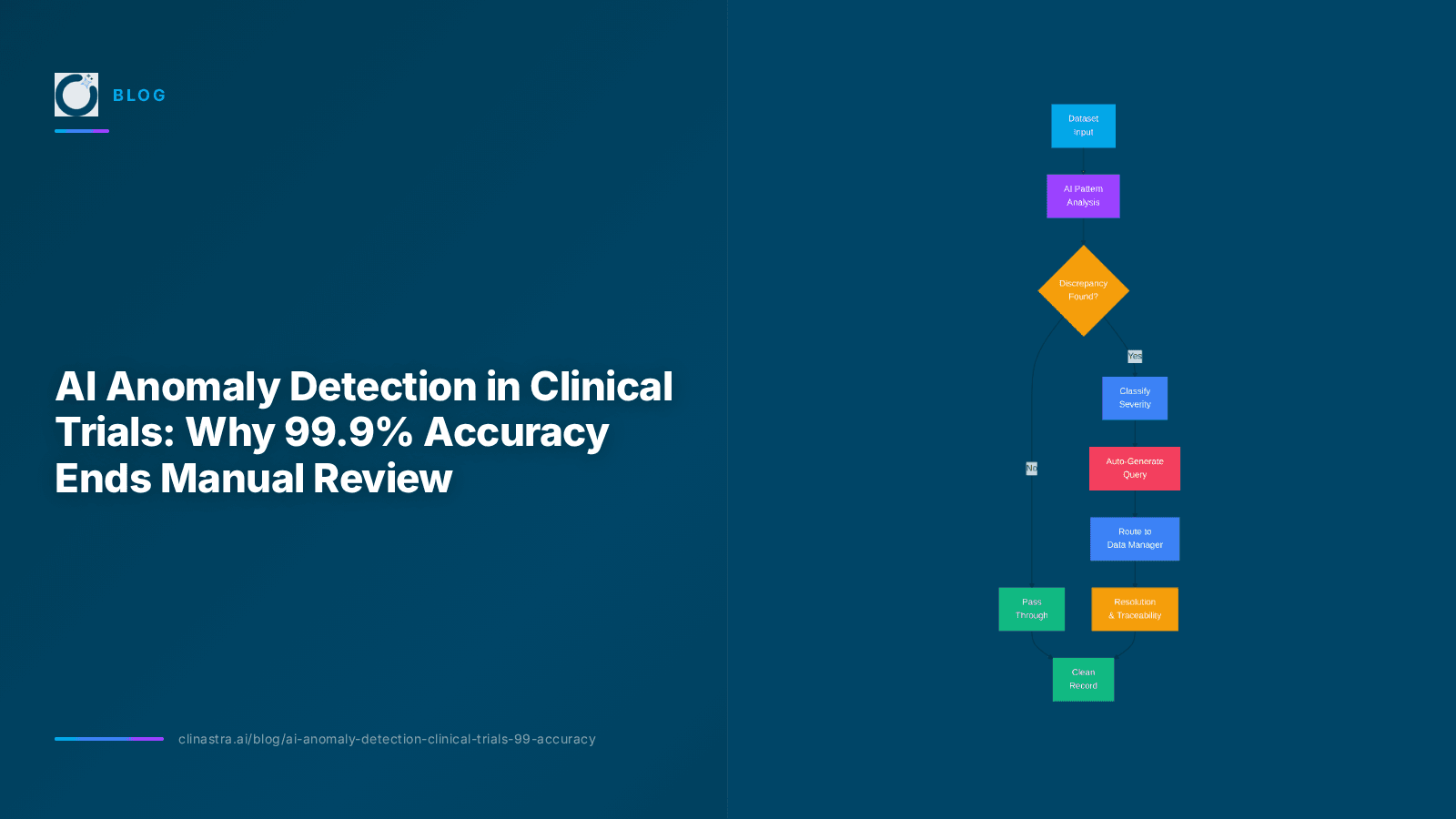
- AI-native review eliminates these bottlenecks by performing in seconds what takes reviewers days — anomaly detection at 99.9% accuracy, automated query generation, and audit-ready traceability built into every flag.
- Every week shaved off the review timeline is a week a patient gets access to therapy sooner. The review bottleneck is not just an operational problem — it is a patient access problem.
Executive Summary
Clinical trial data review is broken. Not slightly inefficient. Not "could use some optimization." Broken in the way that a horse-drawn carriage is broken as a transportation solution in 2026 — it worked once, it technically still moves, but nobody who has seen the alternative would choose it.
The numbers are damning. According to the Tufts Center for the Study of Drug Development (CSDD), the average Phase III trial takes 5–7 years from first-patient-in to database lock. Of that timeline, data review and reconciliation consume 8–14 weeks — and that estimate is conservative because it assumes everything goes smoothly. When review bottlenecks compound with query backlogs, staffing gaps, or protocol amendments, the delay stretches further. A 2024 IQVIA report on clinical development productivity found that trial cycle times have not meaningfully improved in two decades, even as every other component of drug development — molecule design, patient recruitment technology, adaptive trial designs, regulatory review processes — has gotten faster.
The reason is simple, and nobody in clinical operations will deny it privately: data review is not a human job anymore. The volume, velocity, and complexity of modern clinical trial data exceed what manual review can handle. A Phase III trial generates millions of data points across dozens of SDTM domains. Reviewers are expected to manually scan listings, cross-reference lab values against eligibility criteria, identify outliers in safety data, reconcile adverse events across domains, and catch discrepancies between the EDC and external data sources — all before database lock. This is a computation problem hiding inside a human workflow, and the industry has been forcing humans to do computation for 20 years.
This article identifies the seven specific bottlenecks that account for the vast majority of data review delays, explains why each one exists, and shows how AI-native review eliminates them — not by assisting reviewers, but by replacing the manual review process entirely. We have lived these bottlenecks. We built ClinAstra because we refused to accept them.
The Seven Clinical Trial Data Review Bottlenecks Killing Your Timeline
Every clinical data manager knows the feeling: you are three weeks from database lock, the query backlog is growing, the sponsor is asking for status updates daily, and your reviewers are working evenings and weekends to clear listings that should have been automated years ago. The bottlenecks below are not theoretical — they are the exact pain points we encountered across years of clinical data management work before building ClinAstra.
1. Manual Listing Review — The Cell-by-Cell Trap
Manual listing review is the original sin of clinical data review. Reviewers are given SDTM domain listings — sometimes thousands of rows across AE, LB, VS, DM, EX, and other domains — and asked to visually scan for anomalies, outliers, protocol deviations, and data entry errors. This is the equivalent of asking someone to proofread a 10,000-page document by reading every word. It is slow, it is error-prone, and it is the single biggest consumer of reviewer time in the entire data review process.
A typical Phase III trial produces 2,000+ listings across all SDTM domains. At an average of 15–20 minutes per listing (a generous estimate for thorough review), that is 500–670 reviewer-hours — or roughly 3–4 full-time reviewers working for an entire month. And that assumes no re-review after queries are resolved. In practice, listings are reviewed multiple times as new data arrives, inflating the total review effort by 3–5x.
The bottleneck: Human visual scanning is fundamentally limited by cognitive bandwidth. A reviewer can actively process one data point at a time. An AI review engine processes every data point simultaneously, comparing each value against historical baselines, cross-domain logic, protocol specifications, and regulatory conformance rules — in seconds, not weeks.
2. Edit Check Management — Rules Built, Rules Forgotten
Edit checks are the automated validation rules that fire when data violates a pre-specified condition — an out-of-range lab value, a missing required field, a date inconsistency. In theory, edit checks should catch most data issues automatically. In practice, edit check management is its own bottleneck.
The problem is lifecycle. Edit checks are designed during study setup, often months before first-patient-in. As the trial evolves — protocol amendments, new sites, new data collection forms — the edit checks become stale. Some fire on data patterns that are no longer relevant, generating noise. Others miss new error patterns that the original rule set didn't anticipate. Someone has to maintain, test, and update the edit check library throughout the trial, and that maintenance is almost always deprioritized in favor of clearing the query backlog.
According to SCDM's Good Clinical Data Management Practices (GCDMP), edit check validation is a critical but resource-intensive activity. The result: edit checks catch the easy errors but miss the complex, cross-domain discrepancies that require contextual understanding — exactly the errors that delay database lock.
The bottleneck: Static rules cannot adapt to evolving trial data. AI-native review doesn't rely on pre-programmed edit checks — it learns the data patterns of each trial and detects anomalies that no rule was written to catch.
3. Query Resolution Cycles — The Ping-Pong Problem
When a discrepancy is identified — by an edit check, a reviewer, or a statistical analysis — a query is raised. The query goes to the site. The site responds. The reviewer evaluates the response. If the response is unsatisfactory, the query is bounced back. This cycle repeats, sometimes 3–5 times per query, before resolution.
Tufts CSDD data shows that the average query takes 11–18 days to resolve, with complex queries taking 30+ days. A Phase III trial generates 5,000–15,000 queries. Even at the low end, that is 55,000 query-days of resolution time. The query resolution cycle is not just a delay — it is a multiplier, because unresolved queries block downstream activities like reconciliation, SDTM conversion, and database lock.
The bottleneck: Manual query generation is slow and often lacks the evidence the site needs to respond efficiently. AI-generated queries include the exact discrepancy, the cross-domain context, and the suggested resolution — cutting query resolution time from weeks to hours.
4. Reconciliation Across Domains — The Cross-Reference Nightmare
Reconciliation is the process of ensuring data consistency across different sources and domains. AE reconciliation compares adverse events in the AE domain against safety narratives in the SAE domain. Lab reconciliation compares EDC lab values against central lab data. Concomitant medication reconciliation checks that medications in CM match treatment exposure in EX. SAE reconciliation cross-references the safety database against the clinical database.
Each reconciliation is a manual cross-referencing exercise. A reviewer pulls two listings, aligns them by subject ID and visit, and visually confirms consistency. For a trial with 500 subjects and 12 visits, that is 6,000 subject-visit pairs to reconcile per domain pair. With 4–6 reconciliation streams per trial, the effort compounds exponentially.
The bottleneck: Manual reconciliation is a join operation — the kind of task databases were invented to automate. An AI review engine performs reconciliation across all domain pairs simultaneously, flagging every discrepancy with full traceability in seconds.
5. Safety Signal Detection — The Delay That Has Consequences
Safety signal detection in clinical trials requires identifying patterns in adverse event data that may indicate a drug-related safety concern. In manual review, this means scanning AE listings for frequency anomalies, severity escalations, and temporal patterns. The reviewer is looking for a signal in noise, and the noise is enormous — a Phase III oncology trial may record 50,000+ adverse events across the study.
FDA guidance on safety reporting (21 CFR 312.32) requires timely identification and reporting of serious adverse events. When safety signal detection is bottlenecked by manual review, the delay is not just operational — it is a regulatory and patient safety risk. A safety signal identified two weeks late is two weeks during which patients may have been exposed to an undetected risk.
The bottleneck: Manual safety review is reactive and slow. AI-native review continuously monitors AE data in real time, detecting frequency shifts, severity escalations, and temporal clustering that no human reviewer scanning a listing would catch — and flagging them for pharmacovigilance review immediately.
6. SDTM and ADaM Conformance — The Standard That Creates Its Own Bottleneck
SDTM (Study Data Tabulation Model) and ADaM (Analysis Data Model) are the CDISC standards that FDA requires for regulatory submissions. Every clinical trial must produce SDTM and ADaM datasets that conform to these standards before the data can be submitted.
The conformance review is a bottleneck because it is a comprehensive audit of every domain, every variable, every value against the CDISC standard and the FDA's validation rules. The FDA's Study Data Technical Conformance Guide specifies hundreds of conformance checks. Manual SDTM conformance review means running validation tools, interpreting the output, and manually resolving every flagged issue — a process that takes 2–4 weeks for a typical Phase III trial.
The bottleneck: Conformance checking is rule-based validation — a perfect application for AI. An AI review engine validates every SDTM and ADaM dataset against CDISC standards and FDA validation rules in minutes, flagging non-conformances with the exact rule violated and the corrective action required.
7. Database Lock Preparation — The Final Gauntlet
Database lock is the moment the clinical database is frozen and no further edits are permitted. It is the gate between data collection and statistical analysis, and it is the culmination of the entire data review process. Every unresolved query, every reconciliation gap, every conformance issue must be resolved before lock.
The result is a predictable pattern: the weeks before database lock are a mad scramble. Reviewers work overtime. Queries are triaged by severity. The database lock date slips — sometimes by days, sometimes by weeks. And each day of delay pushes the entire downstream timeline: statistical analysis, clinical study report, regulatory submission, and ultimately, patient access to therapy.
The bottleneck: Database lock preparation is the accumulation of every upstream review bottleneck. When review is continuous and AI-native, there is no pre-lock scramble — data is reviewed in real time, queries are resolved as they arise, and database lock becomes a formality rather than a crisis.
Manual Review vs. AI-Native Review: The Bottleneck Comparison
The table below quantifies the difference between manual review and AI-native review across each bottleneck. These are not estimates pulled from marketing materials — they are derived from the operational realities of clinical data management and the demonstrated capabilities of ClinAstra's AI review engine.
| Review Activity |
Manual Review Time |
AI-Native Review Time |
Time Reduction |
| Listing review (all SDTM domains) |
500–670 reviewer-hours |
Minutes (automated, continuous) |
~99% |
| Edit check management |
Ongoing manual maintenance |
Adaptive, self-learning rules |
Maintenance eliminated |
| Query resolution cycles |
11–18 days average per query |
Hours (context-rich queries) |
~90% |
| Cross-domain reconciliation |
2–3 weeks per reconciliation stream |
Seconds (all domains simultaneously) |
~99% |
| Safety signal detection |
Reactive, days to weeks |
Real-time, continuous monitoring |
From reactive to proactive |
| SDTM/ADaM conformance |
2–4 weeks |
Minutes (automated validation) |
~95% |
| Database lock preparation |
2–6 week scramble |
Formality (continuous review) |
Crisis eliminated |
The cumulative effect is transformative. A trial that spends 8–14 weeks in manual data review can reduce that to days — not by working faster, but by eliminating the manual process entirely. From months to days.
How to Identify Your Trial's Review Bottlenecks: A Step-by-Step Guide
Before you can eliminate a bottleneck, you have to find it. Most clinical operations teams know their review process is slow, but they cannot pinpoint where the time goes because they do not measure it. The following steps give you a framework for identifying and quantifying the specific bottlenecks in your trial's data review process.
- Audit your review workflow end-to-end. Map every step from data entry to database lock. For each step, record: who performs it, how long it takes, how many times it is repeated, and what triggers rework. This audit will reveal where time is actually spent versus where you think it is spent. Most teams discover that 60–70% of review time goes to manual listing review and query resolution — not the activities they expected.
- Measure query metrics by domain and query type. Track query volume, resolution time, and bounce rate (queries returned for rework) by SDTM domain. Domains with high query volume and long resolution times are your primary bottlenecks. AE and LB domains typically account for 40–60% of all queries in a Phase III trial.
- Track reconciliation cycle times. For each reconciliation stream (AE/SAE, lab/central lab, CM/EX, safety/clinical), measure the time from data availability to reconciliation completion. Reconciliation delays are often invisible because they are performed between other activities, but they block database lock.
- Quantify the pre-lock scramble. Measure the time between your planned database lock date and your actual lock date. Then measure the reviewer hours consumed in the final 2 weeks before lock. If your pre-lock reviewer hours exceed 30% of total review hours, your process is back-loaded — meaning review is not continuous, it is compressed into a crisis.
- Benchmark against AI-native review. For each bottleneck identified, calculate the time AI-native review would take. Use the comparison table above as a starting point. The gap between your current process and AI-native review is your opportunity — measured in weeks of timeline reduction and hundreds of reviewer-hours saved.
- Calculate the patient impact. Convert your timeline reduction into patient access days. If AI-native review saves 6 weeks, that is 42 days earlier that patients can access the therapy. For a drug treating a life-threatening condition, 42 days is not a metric — it is a lifetime.
- Prioritize replacement, not assistance. The biggest mistake teams make is trying to use AI to assist manual review — running AI alongside the human reviewer, generating suggestions that the reviewer still has to evaluate. This doubles the work. Replace the manual review step entirely. Let AI perform the review, generate the queries, and produce the audit trail. Human reviewers focus on decisions, not data scanning.
The Clinical Data Review Bottleneck Checklist
Use this checklist to assess whether your trial's data review process is bottlenecked by manual work:
- ☐ Reviewers spend more than 50% of their time scanning data listings manually
- ☐ Query resolution time exceeds 10 days on average
- ☐ More than 20% of queries are bounced back at least once before resolution
- ☐ Reconciliation is performed manually by cross-referencing printed or screen-shared listings
- ☐ Edit checks were defined at study startup and have not been updated since
- ☐ Safety signal detection relies on manual AE listing review at scheduled intervals
- ☐ SDTM conformance review begins only after all data is collected, not continuously
- ☐ Database lock preparation involves overtime, weekend work, or schedule slippage
- ☐ Reviewer capacity is the limiting factor in your data review timeline
- ☐ You cannot produce a real-time data quality scorecard at any point during the trial
If you checked five or more items, your data review process is bottlenecked by manual work. Data review is not a human job anymore — and your timeline is paying the price.
Why the Industry Refuses to Fix This
The clinical trial industry has known about the data review bottleneck for decades. SCDM's GCDMP, first published in 2000 and updated multiple times since, acknowledges the resource intensity of manual data review. FDA's 2013 guidance on electronic source data in clinical investigations highlighted the need for more efficient review processes. Every CDM who has worked on a Phase III trial has felt the bottleneck firsthand.
So why hasn't it been fixed? Three reasons:
1. The bottleneck is invisible to leadership. Clinical operations leaders see the timeline — first-patient-in to database lock — as a single number. They do not see the internal breakdown: how much time is spent on listing review vs. query resolution vs. reconciliation vs. conformance. The bottleneck hides inside the aggregate. No one questions it because no one measures it.
2. "That's how it's always been done" is the most expensive sentence in clinical research. Manual data review is the default. It is what every CDM was trained to do. It is what every CRO's SOP specifies. Changing it requires someone to say: the default is wrong. That is uncomfortable. It is also necessary.
3. AI was not ready — until now. For 20 years, the alternative to manual review was "more automation" — more edit checks, more automated listings, more EDC features. None of these replaced the human reviewer. They just gave the human reviewer more tools to work with. AI-native review is different. It does not assist the reviewer. It replaces the review function with a computation engine that is faster, more accurate, and more consistent than any human team.
"We spent years inside the manual review grind — scrolling through thousands of listings, reconciling domains by hand, watching database lock dates slip while reviewers worked weekends. We knew the bottleneck was review, not science. We built ClinAstra because we refused to accept that the status quo was acceptable. Every flag we generate, every query we raise, every reconciliation we perform in seconds instead of weeks — it is the answer to a problem we lived. Built in the trenches, not the ivory tower."
What AI-Native Review Looks Like in Practice
AI-native review is not a tool you add to your existing process. It is a different process. Here is how it works:
Continuous review, not batch review. Instead of reviewing data at scheduled intervals (weekly, monthly, pre-lock), AI-native review runs continuously. Every data point is reviewed the moment it enters the EDC. Anomalies are flagged in real time. Queries are generated immediately, with full context. The reviewer sees a dashboard of exceptions, not a wall of listings.
Cross-domain intelligence, not siloed review. Manual review examines each domain independently — AE listings, then LB listings, then VS listings. AI-native review examines all domains simultaneously, understanding that a lab abnormality in LB may correlate with an adverse event in AE, a medication change in CM, and a protocol deviation in DV. Cross-domain discrepancies that a human reviewer would never catch by reading listings sequentially are flagged instantly.
Traceable flags, not black-box outputs. Every anomaly detected by AI-native review comes with a full audit trail: what was detected, why it was flagged, what rule or pattern triggered the flag, and what evidence supports the finding. Audit-ready by design. No black boxes. No "trust the AI." The methodology is transparent, the evidence is traceable, and the regulatory inspector can follow every flag from detection to resolution.
Adaptive learning, not static rules. The AI review engine learns the data patterns of each trial — the expected ranges for each lab parameter at each site, the typical AE profile for the therapeutic area, the common data entry patterns at each site. It adapts as the trial evolves, catching new error patterns that static edit checks were never designed to detect.
Practical Action Items for Clinical Operations Leaders
If you are responsible for trial timelines and data quality, here is what you can do today to start eliminating the review bottleneck:
- Measure your review timeline. Break down your data review process by activity and quantify the time spent on each. You cannot eliminate a bottleneck you have not measured. Start with the bottleneck checklist above.
- Calculate the cost of your manual review. Multiply your reviewer hours by loaded labor cost. Add the cost of timeline delay — each day of delay in a Phase III trial costs $37,000–$50,000 in direct operational costs, according to Tufts CSDD estimates, before counting opportunity cost.
- Pilot AI-native review on your next trial. Run ClinAstra alongside your existing review process for one domain — start with AE or LB, the highest-volume domains. Compare the AI-generated flags and queries against your manual review results. Measure the time difference, the accuracy difference, and the query resolution time difference.
- Shift reviewer roles from scanning to deciding. When AI handles the review, your reviewers become decision-makers: evaluating flagged anomalies, approving query resolutions, making clinical significance determinations. Review less. Decide more. This is not a downgrade of the reviewer role — it is an upgrade.
- Connect the timeline to the patient. When you present the time savings to your leadership team, frame it in two layers: the operational savings (weeks, dollars, reviewer hours) and the patient impact (days of earlier access to therapy). Every day saved is a day a patient waits less.
Frequently Asked Questions
What is the biggest bottleneck in clinical trial data review?
Manual listing review is the single biggest bottleneck, consuming 50–70% of total reviewer time. Reviewers manually scan thousands of data rows across SDTM domains, a process that is structurally limited by human cognitive bandwidth. AI-native review eliminates this bottleneck by reviewing every data point simultaneously in seconds.
How long does manual data review take in a Phase III trial?
Manual data review in a Phase III trial typically consumes 8–14 weeks, encompassing listing review, query resolution, reconciliation, safety review, SDTM conformance, and database lock preparation. AI-native review reduces this to days by performing each activity automatically and continuously.
Can AI replace manual clinical data review entirely?
Yes. AI-native review engines like ClinAstra perform anomaly detection at 99.9% accuracy, automated query generation with full context, cross-domain reconciliation, safety signal monitoring, and SDTM/ADaM conformance validation — all with audit-ready traceability. The human reviewer's role shifts from scanning data to making decisions about flagged exceptions.
Is AI-based clinical data review compliant with FDA requirements?
AI-native review is compliant when it produces audit-ready outputs: every flag is traceable, every query includes evidence, and the methodology is transparent. FDA's 21 CFR Part 11 requirements for electronic records apply to AI-generated review outputs the same way they apply to manual review documentation. ClinAstra is audit-ready by design, with full traceability for every action.
How does AI-native review handle cross-domain discrepancies?
AI-native review examines all SDTM domains simultaneously, detecting discrepancies that require cross-domain logic — for example, a lab abnormality in LB that should trigger an AE entry, or a medication in CM that conflicts with treatment exposure in EX. Manual review misses these because each domain is reviewed independently. AI catches them in seconds.
What is the patient impact of reducing data review time?
Reducing data review from weeks to days directly shortens the time from database lock to regulatory submission to drug approval. Every week saved in the review process is a week earlier that patients can access the therapy. For drugs treating life-threatening conditions, this is not a metric — it is a matter of survival.
Conclusion: The Bottleneck Is a Choice
The clinical trial data review bottleneck is not a law of nature. It is not an unavoidable cost of conducting clinical research. It is a choice — the choice to keep doing review the way it was done in 2005, with humans scanning listings while millions of data points pile up around them.
Every other part of the clinical development process has evolved. Molecule design uses computational chemistry. Patient recruitment uses digital outreach. Trial monitoring uses risk-based approaches. Statistical analysis uses advanced computation. Data review is the last relic of the manual era, and it is the bottleneck that holds everything else back.
ClinAstra was built by people who lived this bottleneck — who spent years inside the manual review grind and refused to accept it as inevitable. We built an AI review engine that detects anomalies with 99.9% accuracy, generates queries with full context, reconciles domains in seconds, and produces an audit trail for every action. Not to assist reviewers. To replace the process that is slowing your trial down.
The question is not whether AI can handle your clinical data review. The question is whether you can afford to keep doing it manually while your competitors move from months to days.
Stop reviewing data manually. Start reviewing intelligently.