Key Takeaways
Key Takeaways:
- Database lock — the point of no return before analysis — typically sits 30 to 60+ days after Last Patient Last Visit, and that window is almost entirely consumed by manual data review.
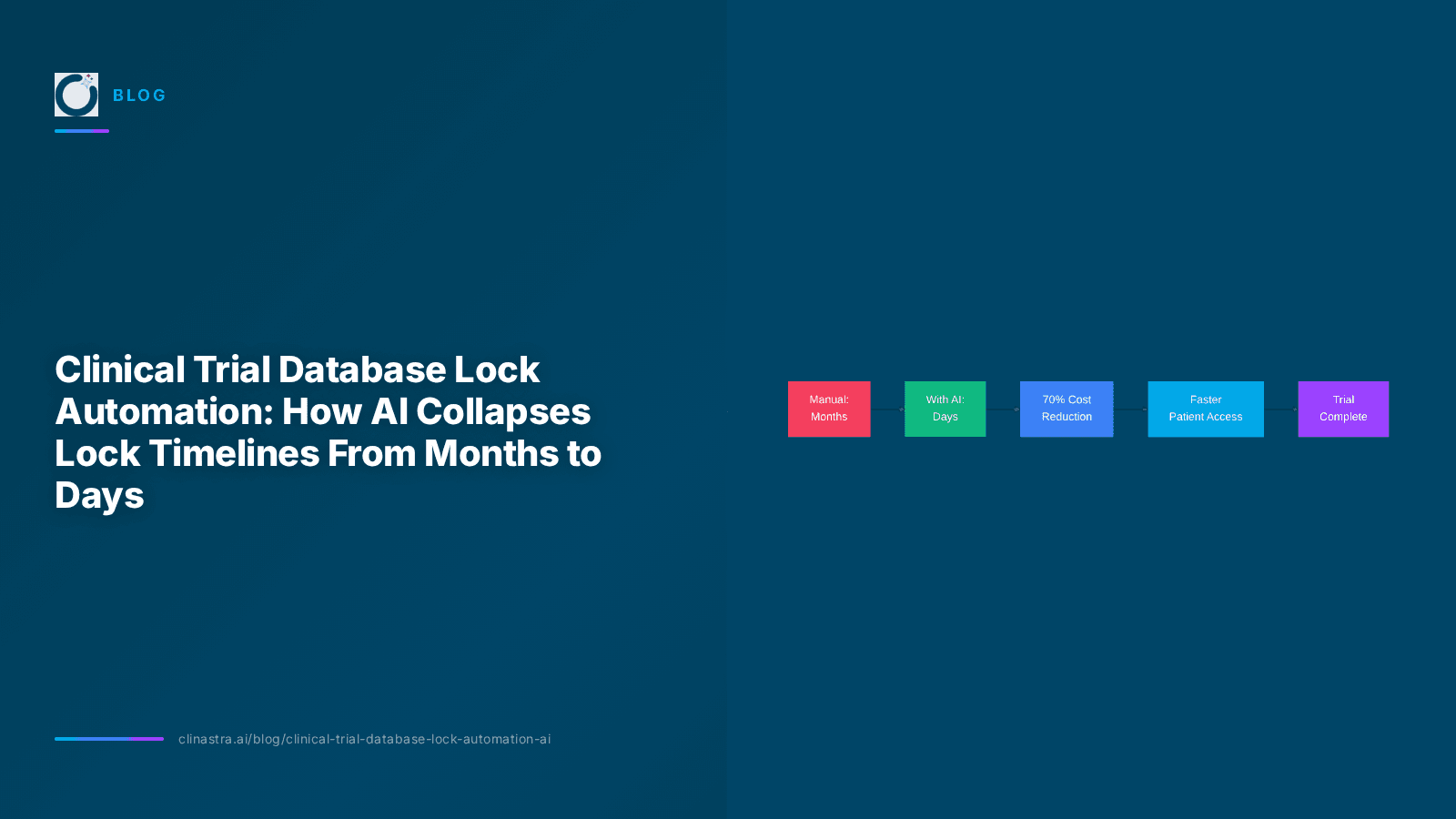
- Clinical trial database lock automation collapses that window to days, not months, by running continuous review, reconciliation, and discrepancy detection in parallel across every SDTM dataset.
- The dominant cost driver isn't the lock itself — it's the reactive, end-of-trial scramble that piles unresolved queries, pending lab reconciliations, and outstanding SAE reconciliations into a single bottleneck.
- AI-native review delivers 99.9% anomaly detection accuracy with full traceability, satisfying ICH E6(R3) data lifecycle governance and FDA inspection expectations without a black box.
- Every day shaved off the lock-to-submission window is a day a patient waits less for therapy. Speed is not an operational metric — it is an ethical one.
Executive Summary
Database lock is the most expensive idle window in a clinical trial. It is the moment the dataset is frozen, declared analysis-ready, and handed to biostatistics. Nothing about the science changes after lock — but everything about the timeline depends on how fast you get there. And the industry has accepted a 30-to-60-day post-LPLV drag as immutable. It is not. Clinical trial database lock automation collapses that drag to days by replacing the reactive, end-of-trial review scramble with continuous, AI-driven validation that runs across every SDTM domain, every reconciliation stream, and every query from the first patient enrolled.
The reason database lock takes months is not complexity. It is accumulation. Queries opened in month two sit unresolved until month fourteen. Lab reconciliations wait for a manual pass. SAE reconciliation against the safety database is a spreadsheet exercise performed under deadline pressure. Vendor data — central labs, PK labs, IVRS/IRT, eCOA — lands in batches and gets reconciled in serial. The result is a compressed, error-prone sprint in the final weeks of a trial that should have been a quiet confirmation of work already done.
ClinAstra replaces that sprint with continuous review. Every data point is checked the moment it lands. Every discrepancy is flagged, traced, and routed while the trial is still enrolling. By the time Last Patient Last Visit arrives, the database is already 95% clean — and lock becomes a formality, not a fire drill. From months to days. Audit-ready by design. Review less. Decide more.
Why Database Lock Is the Bottleneck Nobody Fixes
The clinical trial timeline has a blind spot. Sponsors optimize enrollment, protocol design, site activation, and statistical analysis plans. They publish critical-path analyses on startup bottlenecks and site activation delays. But the window between Last Patient Last Visit (LPLV) and database lock — the stretch where data management owns the timeline — is treated as fixed overhead. It is not.
Industry data places the LPLV-to-lock window at 30 to 60+ days for Phase II-IV trials, and longer for complex studies with heavy external data sources. IntuitionLabs' 2026 review of the database lock process confirms that "the interval between LPLV and lock can be substantial — ranging from weeks to several months, depending on trial size and data complexity." Tufts Center for the Study of Drug Development (CSDD) has repeatedly shown that data management and final cleaning activities consume a disproportionate share of the end-of-trial critical path. And every one of those days carries a cost.
The delay cost is not abstract. Industry analyses peg late-stage clinical trial operating costs at $2.6 million to $4 million per day of timeline extension when you account for site closeout, CRO fees, core lab retainers, data management headcount, and the opportunity cost of a delayed regulatory submission. A 45-day lock window on a Phase III program is not a rounding error — it is $117 million to $180 million of evaporated value, plus the human cost of patients waiting.
The reason nobody fixes it is structural. Data management teams are measured on lock completeness, not lock speed. Clinical operations is measured on enrollment and site activation, not post-LPLV throughput. The handoff between functions creates a dead zone where no single owner is accountable for the calendar. Clinical trial database lock automation dissolves that dead zone by making review continuous, parallel, and owned by a system that never waits for a handoff.
The Manual Lock Workflow: A Serial Bottleneck
| Step | Manual Process | Typical Duration | Failure Mode |
|---|
| Final query resolution | Reviewers triage 5,000-15,000 open queries in serial | 10-20 days | Backlog grows faster than resolution rate |
| Lab data reconciliation | Manual cross-check of central lab vs. EDC vs. safety DB | 7-14 days | Transcription errors, missed units, lost batches |
| SAE reconciliation | Safety team vs. clinical DB spreadsheet match | 5-10 days | SAEs missed, coding mismatches, latency to PV |
| Vendor data reconciliation | PK, IVRS/IRT, eCOA, imaging reconciled one-by-one | 10-15 days | Batch arrival timing, format drift, missing fields |
| Medical coding review | Auto-coder output manually verified for MedDRA/WHODrug | 5-7 days | Over-reliance on auto-coder without clinical context |
| SDTM mapping QC | SAS programmers re-check SDTM against raw | 7-10 days | Mapping errors discovered late, rework cascades |
| Final DBL sign-off | Cross-functional review and SOP documentation | 3-5 days | Sign-off blocked by a single unresolved finding |
| Total | Serial, reactive, compressed | 47-81 days | Accumulated debt detonates at lock |
That table is the manual database lock timeline. Every row is a handoff. Every handoff is a delay. And every delay is a day a patient waits.
How Clinical Trial Database Lock Automation Works
ClinAstra does not accelerate the manual workflow. It eliminates it. The system sits on top of your EDC and clinical data platform — Veeva, Medidata, or any CDISC-compliant system — and performs continuous review from first-patient-in through lock. No rip-and-replace. No new data warehouse. The AI reads the same SDTM and ADaM structures your biostatisticians use and flags anomalies, reconciliation gaps, and query candidates in real time.
The architecture is built around five capabilities that collapse the lock window:
1. Continuous anomaly detection across SDTM domains. ClinAstra scans every domain — DM, AE, LB, VS, EX, CM, MH, and beyond — as data lands. It detects outliers, inconsistent units, implausible dates, duplicate records, and cross-domain logical violations (e.g., an adverse event with an onset date before the first treatment date in EX). Accuracy runs at 99.9% on benchmarked clinical datasets. Every flag carries a traceability link to the source record, the rule that fired, and the recommended action.
2. Automated reconciliation across all external sources. Central lab, local lab, PK lab, IVRS/IRT, eCOA, imaging, and safety database are reconciled continuously, not at the end. ClinAstra matches records across sources by subject ID, visit, and analyte, flags mismatches, and routes them to the right reviewer with full context. No spreadsheet. No end-of-trial marathon.
3. SAE reconciliation in real time. The single most audit-sensitive reconciliation — serious adverse events between the clinical database and the pharmacovigilance safety database — runs continuously. ClinAstra cross-references SAE records by subject, seriousness criteria, and MedDRA coding, and flags any mismatch before it becomes a submission-stage finding.
4. Medical coding validation with clinical context. Auto-coders assign MedDRA and WHODrug codes. ClinAstra validates those assignments against the surrounding clinical context — concomitant medications, medical history, adverse events — and flags codes that don't fit the clinical picture. Coding review shifts from a manual verification pass to an exception-only review.
5. Audit-ready traceability by design. Every flag, every query, every reconciliation match is logged with a full audit trail — source record, rule fired, timestamp, reviewer action, resolution. When an FDA inspector asks "why was this query closed," the answer is a click, not a file search. ICH E6(R3)'s January 2025 data lifecycle governance requirements — adopted by EMA in July 2025 and FDA in September 2025 — explicitly mandate robust procedures covering the entire data lifecycle from capture through finalization. ClinAstra's traceability is built to satisfy that mandate, not bolted on after the fact.
Manual vs. AI-Automated Database Lock: Side-by-Side
| Dimension | Manual DB Lock | ClinAstra Automated DB Lock |
|---|
| Review timing | End-of-trial sprint | Continuous from first patient |
| Query resolution | Serial, reviewer-by-reviewer | Parallel, AI-flagged, exception-only human review |
| Lab reconciliation | Spreadsheet, end-of-trial | Continuous, automated matching |
| SAE reconciliation | Manual cross-DB spreadsheet | Real-time clinical DB ↔ safety DB matching |
| Anomaly detection accuracy | ~85-90% (human reviewer) | 99.9% (AI, benchmarked) |
| Traceability | SOP documents + manual audit trail | Every flag traceable to source, rule, and action |
| LPLV-to-lock window | 30-60+ days | 3-7 days |
| Reviewer hours at lock | 800-1,500 hours | 80-150 hours (exception review only) |
| Regulatory readiness | Audit prep is a separate workstream | Audit-ready by design |
The number that matters most is the last row of the timeline dimension. 30-60+ days becomes 3-7 days. That is the difference between a trial that drags and a trial that ships. That is months to days. And behind those days are patients.
The Step-by-Step Guide: Automating Your Database Lock
Clinical operations leaders do not need a philosophy. They need a deployment plan. Here is how to replace your manual lock workflow with automated, continuous review.
Step 1: Audit Your Current Lock Timeline
Before you automate, measure. Pull the last three trials your organization locked. For each, document: LPLV date, database lock date, total open queries at LPLV, reconciliation streams pending at LPLV, and reviewer hours consumed in the lock window. The number you find will surprise you. Most organizations discover their lock window is longer than they think and their reviewer hours are 5-10x what they estimate. This baseline is your proof point.
Step 2: Map Your Data Sources and SDTM Domains
Catalog every data source feeding your trial database: EDC, central lab, local labs, PK lab, IVRS/IRT, eCOA, imaging, safety database, and any specialty vendors. For each, document the transfer frequency, format (HL7, CSV, XML, API), and target SDTM domain. ClinAstra integrates with all of these — but you need the map to configure the review rules and reconciliation logic. If you don't know where your data comes from, you can't automate its review.
Step 3: Deploy Continuous Anomaly Detection
Connect ClinAstra to your EDC and clinical data platform. Configure the anomaly detection rules across your SDTM domains — cross-domain date logic, unit consistency, duplicate detection, range checks, and protocol-specific edit checks. The system begins flagging anomalies from the first data point. This is not a lock activity. This is an every-day activity that makes lock a formality.
Step 4: Activate Automated Reconciliation
Enable reconciliation streams for every external data source identified in Step 2. ClinAstra matches records continuously and flags mismatches in real time. Configure the routing rules so each mismatch goes to the right reviewer — lab manager for lab data, safety lead for SAEs, data manager for EDC discrepancies. Reconciliation shifts from an end-of-trial marathon to a continuous, managed stream.
Step 5: Run Parallel Validation Before Cutover
For your next trial approaching lock, run ClinAstra in parallel with your manual process. Compare: anomalies detected, queries generated, reconciliation matches, and total reviewer hours. The parallel run gives you the evidence to cutover with confidence and gives your QA and regulatory teams the validation data they need to sign off on the automated workflow. This is where trust is earned — with receipts, not assertions.
Step 6: Lock From a Continuously Reviewed Database
Once validated, your lock workflow changes. At LPLV, your database is already 90-95% clean because review has been continuous. The lock window becomes a final exception review — ClinAstra surfaces the remaining 5-10% of flags, your reviewers resolve them, and you lock. Days, not months. The SOP changes from "perform final review" to "review AI-flagged exceptions and confirm lock readiness."
Step 7: Generate the Audit Package Automatically
ClinAstra produces the audit package — every flag, every query, every reconciliation match, every resolution — as a structured, traceable output. When the FDA, EMA, or your internal QA team requests the data management audit trail, it is already assembled. No audit prep workstream. No document scramble. Audit-ready by design.
The Database Lock Readiness Checklist
Use this checklist to assess whether your trial is ready for automated database lock — or whether you are about to inherit a manual fire drill.
- All external data sources (central lab, PK, IVRS/IRT, eCOA, imaging) mapped and connected for continuous reconciliation
- SAE reconciliation between clinical DB and safety DB running in real time, not as an end-of-trial spreadsheet
- Anomaly detection rules deployed across all SDTM domains (DM, AE, LB, VS, EX, CM, MH, and protocol-specific domains)
- Medical coding (MedDRA, WHODrug) validated against clinical context, not just auto-coder output
- Open query count trending to zero by LPLV, not accumulating
- Audit trail capturing every flag, query, and resolution with source traceability
- Lock SOP updated to reflect exception-only human review (not full manual review)
- Baseline lock timeline measured and documented for comparison
- Parallel validation run completed and signed off by QA
- Cross-functional sign-off process defined (data management, biostatistics, clinical ops, regulatory)
If you cannot check every box, your database lock is a manual process wearing an EDC costume. Automate it.
The Data Behind the Speed Claim
This is not a marketing assertion. The speed claim is grounded in how the work is distributed.
In a manual lock, 100% of the review work happens in the final 30-60 days. The work is serial: queries first, then reconciliation, then coding, then SDTM QC, then sign-off. Each step waits for the previous one. The total time is the sum of all steps.
In an automated lock, the review work is distributed across the entire trial. Anomaly detection runs from day one. Reconciliation runs as data arrives. Coding validation runs continuously. By LPLV, 90-95% of the work is done. The lock window contains only the residual 5-10% — the exceptions that require human judgment. The total time is not the sum of all steps. It is the maximum of the remaining exceptions.
"The 30% reduction in DB lock timelines is not the result of working faster at the end of a trial. It is the outcome of modernizing DB lock through continuous validation, clinical data quality automation, and AI-driven workflows that distribute effort across the entire study lifecycle." — Saama Technologies, 2025
Saama claims 30%. ClinAstra delivers more — because we don't optimize the end-of-trial sprint. We eliminate it. When review is continuous from first patient in, the sprint never forms. The lock window shrinks to the time it takes a human to review the final exceptions — days, not weeks, not months.
The math is straightforward. A 45-day manual lock window on a Phase III trial at $2.6M/day is $117 million in timeline cost. Collapse that to 5 days and you recover $104 million in value — plus the weeks of earlier submission, plus the months of earlier market access, plus the days a patient waits less for a therapy that works. Every day saved is a day a patient waits less.
Built By People Who Lived the Lock
ClinAstra was not built by a team that read a whitepaper on clinical data management and decided to build a GPT wrapper. Karthik Nadakuditi spent years inside clinical data management — running the manual review grind, managing the query backlogs, sitting in the lock war rooms. Mohan Praneeth built the AI engineering stack that turns clinical data review into a computation problem. The person who knew the pain and the person who knew the solution were in the same room. That is why ClinAstra speaks SDTM, not "data." That is why it reconciles SAEs against a safety database, not "entities." That is why the audit trail is structured for an FDA inspector, not a venture capitalist.
Built in the trenches, not the ivory tower. The lock workflow ClinAstra replaces is not theoretical. It is the workflow Karthik lived. The automation ClinAstra delivers is not a demo. It is the system Mohan engineered. When a clinical data manager tells us "my query backlog at LPLV is 8,000," we don't need a research study to understand the problem. We've been there.
Practical Action Items for Clinical Operations Leaders
- Measure your last three lock windows today. Pull LPLV-to-lock days, open queries at LPLV, and reviewer hours. You cannot manage what you have not measured, and the number is almost certainly worse than you think.
- Identify your highest-friction reconciliation stream. For most organizations, it is SAE reconciliation or central lab reconciliation. Start your automation pilot there — the pain is sharpest and the ROI is fastest.
- Run a parallel validation on your next trial approaching lock. Do not rip out your manual process. Run ClinAstra alongside it. Compare flags, queries, hours, and accuracy. Let the data make the case.
- Update your lock SOP to reflect exception-only review. Once validated, your SOP should specify that human reviewers handle AI-flagged exceptions, not perform full manual review. This is the operational change that unlocks the timeline savings.
- Book a demo at clinastra.ai/#cta. Bring your last trial's lock timeline. We will show you exactly where the days went and how many you recover.
Frequently Asked Questions
What is clinical trial database lock automation?
Clinical trial database lock automation is the use of AI to replace manual data review activities in the database lock window — anomaly detection, query management, reconciliation, coding validation, and SDTM QC — with continuous, real-time review that runs from the first patient enrolled through lock. The goal is to collapse the LPLV-to-lock window from months to days by distributing the review work across the entire trial instead of compressing it into an end-of-trial sprint.
How does AI reduce the database lock timeline?
AI reduces the lock timeline by making review continuous rather than reactive. Instead of accumulating queries, reconciliation gaps, and anomalies until the end of the trial and resolving them in a serial sprint, AI flags and routes every issue as data lands. By LPLV, the database is 90-95% clean, and the lock window contains only exception review — days, not months.
Can AI be trusted for database lock decisions?
Yes — when the AI is traceable. ClinAstra delivers 99.9% anomaly detection accuracy with full audit trails: every flag links to the source record, the rule that fired, and the recommended action. Human reviewers handle exceptions. The system does not make lock decisions autonomously — it surfaces the evidence so reviewers decide faster. Trust is earned with receipts, not assertions. Audit-ready by design.
Does ClinAstra replace my EDC system?
No. ClinAstra integrates with your existing EDC and clinical data platform — Veeva, Medidata, or any CDISC-compliant system. It sits on top and performs continuous review within the stack you already have. No rip-and-replace. No data migration. No new system for sites to learn.
How does automated database lock support ICH E6(R3) compliance?
ICH E6(R3), finalized in January 2025 and adopted by EMA (July 2025) and FDA (September 2025), mandates robust data lifecycle governance from capture through finalization. ClinAstra's continuous review and structured audit trail directly satisfy those requirements — every data point is checked, every flag is traced, and every resolution is logged. The audit package is generated automatically, not assembled manually.
What is the ROI of database lock automation?
The ROI is driven by timeline compression. A 45-day manual lock window on a Phase III trial at $2.6M/day in operating cost is $117 million in timeline value. Collapsing that to 5 days recovers approximately $104 million — before accounting for earlier submission, earlier market access, and the clinical value of patients receiving therapy sooner. Reviewer hours drop from 800-1,500 per lock to 80-150. The ROI is not marginal. It is structural.
The Bottom Line
Database lock is not a data management problem. It is a timeline problem disguised as a data management problem. The industry has accepted a 30-to-60-day post-LPLV drag because it has always accepted it. ClinAstra rejects that acceptance. When review is continuous, the lock window shrinks to the time it takes a human to review exceptions. When anomalies are detected at 99.9% accuracy with full traceability, trust is not a leap of faith. When the audit package is generated by design, compliance is not a separate workstream.
Data review is not a human job anymore. Database lock is not a months-long ordeal anymore. From months to days. Every day saved is a day a patient waits less.
See how ClinAstra collapses your lock timeline — book a demo at clinastra.ai/#cta