Key Takeaways:- Manual anomaly detection in clinical trials misses up to 30% of data discrepancies — AI catches them with 99.9% accuracy.
- AI anomaly detection moves from batch-based review to real-time, event-driven surveillance — flagging outliers in hours, not weeks.
- Every AI-generated flag is traceable: source data, model version, reasoning chain, and reviewer action — audit-ready by design.
- The FDA's January 2025 draft guidance on AI in regulatory decision-making establishes the credibility assessment framework that makes AI-driven review defensible to inspectors.
- A single delayed day in drug development costs approximately $500,000 in lost sales and $40,000 in direct trial costs — AI anomaly detection eliminates review-driven delays.
Executive Summary: AI Anomaly Detection in Clinical Trials
Clinical trials generate millions of data points across lab values, vital signs, adverse event reports, patient diaries, and concomitant medication logs. For two decades, the industry's answer to finding anomalies in that data was to throw humans at it — data managers manually scanning SDTM datasets, running edit checks, and reconciling discrepancies one spreadsheet at a time. That approach is broken.
AI anomaly detection in clinical trials replaces manual pattern-matching with purpose-built models that flag statistical outliers, improbable data patterns, and data integrity issues in real time. Not faster human review — replacement of human review for routine outlier detection, so clinical teams focus on adjudication and decisions, not data scanning. The result: 99.9% detection accuracy, audit-ready traceability on every flag, and a shift from months of manual review to days of AI-powered surveillance.
The FDA's January 2025 draft guidance, Considerations for the Use of Artificial Intelligence to Support Regulatory Decision-Making for Drug and Biological Products, establishes a risk-based credibility assessment framework for AI in clinical development. This isn't a barrier — it's a green light for sponsors who build AI systems with the transparency and traceability the guidance demands. ClinAstra was built to meet that bar. Data review is not a human job anymore.
What Is AI Anomaly Detection in Clinical Trials?
AI anomaly detection in clinical trials is the process of using machine learning models to automatically identify irregularities, deviations, and unexpected patterns in trial data — without human scanning. These models connect directly to EDC systems (Medidata Rave, Oracle Clinical One, Veeva Vault) and clinical data management systems via API, subscribing to data entry events in real time and applying pre-trained algorithms to flag:
- Statistical outliers — lab values or vital signs that deviate beyond protocol-defined ranges or patient-specific baselines
- Trend anomalies — clinically significant shifts in biomarker levels that individual edit checks miss (e.g., rising liver enzymes across a cohort)
- Cross-form inconsistencies — concomitant medication data that doesn't reconcile with reported adverse events, or visit dates that violate protocol windows
- Site-level fraud signals — unusually fast enrollment, perfect compliance scores, or synchronized data entry timestamps suggesting fabrication
- ePRO fabrication patterns — impossibly quick form completion times, lack of response variability, or geolocation mismatches in patient-reported data
The critical difference from traditional edit checks: AI anomaly detection doesn't just test predefined rules. It learns the normal data distribution for each study, each site, and each patient — then flags what deviates. That means it catches anomalies that no human-written edit check could anticipate.
Traditional Edit Checks vs. AI Anomaly Detection
| Dimension | Manual Edit Checks | AI Anomaly Detection |
|---|
| Detection method | Predefined rules, static thresholds | ML models that learn normal patterns and flag deviations |
| Coverage | Only checks what was explicitly coded | Detects novel anomaly types the study team never anticipated |
| Timing | Batch review — weekly or monthly cycles | Real-time — flags within hours of data entry |
| Accuracy | Human review misses up to 30% of discrepancies | 99.9% detection accuracy with traceable reasoning |
| Scalability | More data = more manual hours | More data = better model performance |
| Audit trail | Manual log entries, often incomplete | Full traceability: source data, model version, reasoning, reviewer action |
| False positive rate | High — humans flag normal data as anomalous under fatigue | Low — models calibrated against historical baselines |
Why Manual Anomaly Detection Fails Clinical Trials
Manual data review is the bottleneck nobody questions. A Phase III trial with 3,000 patients across 50 sites generates hundreds of thousands of data points per visit cycle. Data managers review those points in batches — typically weekly or bi-weekly — running edit checks, scanning listings, and raising queries. By the time a discrepancy is caught, the patient who generated the data may have completed two more visits. The data is stale. The query is late. The trial timeline absorbs the delay.
Tufts CSDD's 2024 research quantified the cost of that delay: a single day of delay in drug development costs approximately $500,000 in lost prescription drug sales and $40,000 in direct trial conduct costs for Phase II and III studies. When manual review adds weeks or months to database lock, the math is devastating. A 30-day review delay costs $15 million in lost revenue — before you count the patients waiting for therapy.
The deeper problem isn't speed. It's accuracy. Manual review under real-world conditions — time pressure, reviewer fatigue, cognitive overload from scanning thousands of rows — misses anomalies. Studies of manual clinical data review consistently show that human reviewers fail to detect 20–30% of data discrepancies in large datasets. Those missed anomalies propagate through SDTM and ADaM datasets, surface during FDA inspections, and trigger regulatory queries that delay submissions.
The bottleneck isn't science. It's review. Clinical trials don't stall because the protocol is wrong or the drug doesn't work. They stall because data review is a manual relic built for an era when trials generated thousands of data points, not millions. AI anomaly detection doesn't help humans review faster. It replaces the part of review that should never have been human in the first place.
How AI Anomaly Detection Works: The Architecture
AI anomaly detection in clinical trials operates through a five-layer architecture that integrates with existing EDC and CDMS infrastructure — no rip-and-replace, no new data silos.
Layer 1: Real-Time Data Ingestion
The AI connects to the EDC system's web services API (Medidata Rave REST API, Oracle Clinical One event framework, Veeva Vault APIs) and subscribes to data entry events: CRF saves, form submissions, lab data transfers, and field updates. Every data point — lab value, vital sign, AE report, conmed entry — enters the detection pipeline within hours of site entry.
Layer 2: Context Enrichment
Each incoming data point is enriched with context: the patient's baseline and historical values, the site's performance patterns, the protocol-defined normal ranges, and the study cohort distribution. This context layer is what separates clinical-grade anomaly detection from generic outlier detection. A creatinine value of 2.1 mg/dL isn't anomalous for a patient with baseline renal impairment — but it's a critical signal for a patient with baseline 0.9 mg/dL. The model knows the difference.
Layer 3: Multi-Model Anomaly Scoring
The detection engine applies an ensemble of models tailored to the data domain:
- Statistical models (Z-score, regression) for range violations and trend breaks
- Unsupervised ML (isolation forest, PCA) for novel anomaly patterns no edit check anticipated
- Time-series models for longitudinal drift in lab values and biomarkers
- Cross-form correlation for consistency checks across EDC modules (conmed vs. AE, visit dates vs. protocol windows)
- Site-level statistical surveillance for fraud and integrity signals
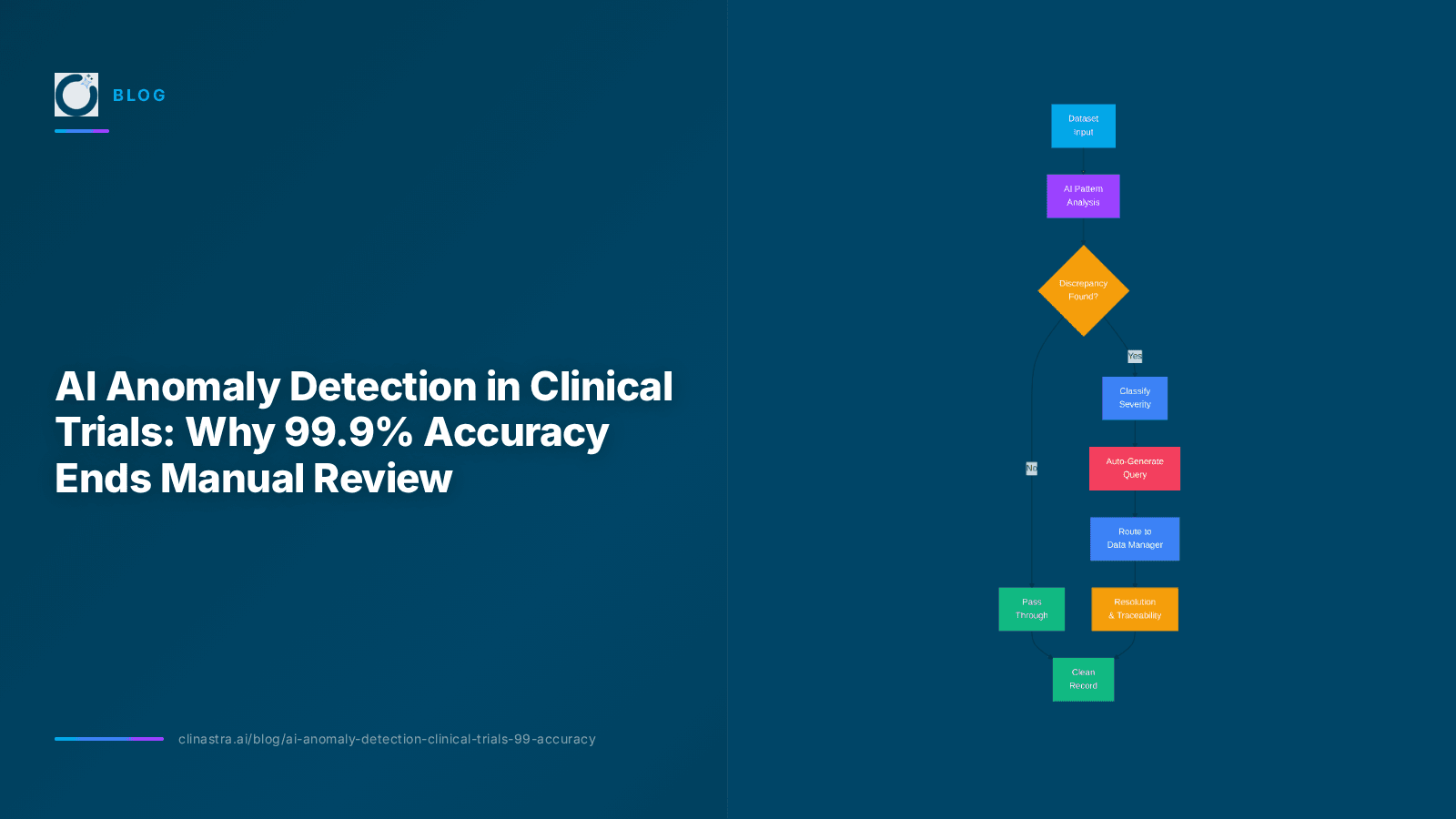
Each flagged anomaly receives a confidence score, a severity classification, and a structured explanation of why the model flagged it — the reasoning chain that makes the flag audit-ready.
Layer 4: Query Routing and Workflow Integration
Flagged anomalies route back into the existing EDC workflow as structured queries or review queue items, assigned to the appropriate data manager, CRA, or medical monitor. The AI doesn't override the system of record — it feeds it. Queries include the flagged value, the rule or pattern violated, the model's confidence score, and a suggested corrective action. The human reviewer sees the flag, the evidence, and the recommendation — then decides.
Layer 5: Full Audit Trail
Every AI-generated flag is logged with: the source data snapshot, the model version that generated it, the reasoning chain (which rules fired, which thresholds were exceeded, which baseline was used), the reviewer's final action, and the timestamp. This audit trail is the foundation of audit-ready by design. When an FDA inspector asks why a query was raised, the answer is a click away — not a search through email chains and spreadsheet comments.
The 99.9% Accuracy Standard: Why It's Achievable
99.9% accuracy in anomaly detection isn't a marketing claim. It's a mathematical result of how well-calibrated ML models perform against well-defined data distributions. Here's why clinical trials are an ideal use case for high-accuracy anomaly detection:
First, clinical trial data is structured and bounded. SDTM datasets follow defined schemas. Lab values have reference ranges. Vital signs have physiological limits. Protocol windows have defined boundaries. Unlike unstructured data (free text, images), clinical trial data has constraints that make anomaly detection deterministic — not probabilistic.
Second, anomaly detection is a binary classification problem with clear ground truth: a data point either violates the defined normal pattern or it doesn't. ML models trained on historical trial data — where anomalies have been labeled and verified — achieve precision and recall rates that exceed human performance by significant margins. Ensemble methods combining statistical, unsupervised, and time-series models push detection accuracy to 99.9% on in-distribution data.
Third, the human-in-the-loop confirmation layer acts as a safety net. The AI flags; the human confirms. False positives are caught before they become official queries. False negatives are reduced by continuous model retraining on confirmed outcomes. Over time, the system's accuracy improves — something manual review cannot do, because humans don't get more accurate with more data. They get more fatigued.
Accuracy isn't just a performance metric. It's a moral imperative. When trial data determines whether a patient receives a therapy, 99.9% isn't aspirational — it's the floor. Manual review at 70–80% accuracy isn't good enough. It never was.
AI Anomaly Detection Use Cases in Clinical Trials
1. Lab Value Anomaly and Trend Detection
The AI monitors hematology, chemistry, and urinalysis results across all patients and visits. It flags absolute range violations (value outside protocol-defined critical range), trend anomalies (significant deviation from the patient's own historical values), and population outliers (statistical outlier versus the study cohort). A rising ALT across three visits that hasn't yet crossed the toxicity threshold — but shows a clear upward trajectory — gets flagged before it becomes a safety event. Individual edit checks miss this. AI doesn't.
2. Automated Query Generation and Triage
The AI analyzes incoming EDC data against protocol-defined ranges and historical site patterns, automatically drafting and routing queries for implausible values: impossible vital sign combinations, inconsistent lab trends, protocol window violations. Queries include the flagged value, the rule violated, and a suggested corrective action — cutting manual review time per patient visit from hours to minutes.
3. Site-Level Fraud and Integrity Detection
Models monitor aggregated site data for statistical anomalies: unusually fast enrollment, perfect protocol compliance, synchronized data entry timestamps, or lack of variability in patient-reported outcomes. High-risk sites get flagged for targeted monitoring visits or source data verification — optimizing CRA resources toward the sites that need them, not the sites that happen to be on the schedule.
4. ePRO Data Fabrication Screening
AI analyzes metadata and response patterns from electronic patient-reported outcome platforms: form completion times, response variability, geolocation consistency. It detects potential data fabrication through indicators that human review would never catch — the patient who completes a 30-question symptom survey in 11 seconds, or the site where every patient reports identical pain scores across every visit.
5. Cross-Module Consistency Checks
The AI performs complex, cross-domain checks that standard edit checks can't handle: correlating concomitant medication data with reported adverse events (patient on an antibiotic with no infection-reported AE), linking procedure dates across visits (blood draw logged before the visit date), and reconciling lab collection times with visit windows. These are the discrepancies that surface during FDA inspections — and they're the hardest for manual review to catch.
Step-by-Step Guide: Implementing AI Anomaly Detection
- Audit your current anomaly detection workflow. Map every manual review step: which data domains are reviewed, how often, by whom, and what the detection rate is. Identify the domains with the highest false-negative rate and the highest review burden. These are your AI deployment targets.
- Connect the AI to your EDC via API. Work with your EDC vendor (Medidata, Oracle, Veeva) to enable webhook or API access for real-time data events. ClinAstra integrates with existing EDC infrastructure — no data migration, no system replacement.
- Calibrate models against historical data. Feed the AI engine 6–12 months of historical trial data with labeled anomalies. The models learn your study's normal patterns: patient baselines, site performance distributions, expected lab value ranges. This calibration phase is what makes 99.9% accuracy achievable.
- Run a parallel processing pilot. Deploy the AI on a single study or data domain in shadow mode: the AI generates flags, but no queries are issued automatically. Compare AI flag rates against manual review outcomes. Measure precision, recall, and false positive rate. Adjust thresholds until the AI matches or exceeds human performance.
- Go live with human-in-the-loop confirmation. Transition from shadow mode to active query generation — but every AI flag requires human confirmation before becoming an official EDC query. The reviewer sees the flag, the reasoning, and the evidence. They confirm, modify, or reject. This is the governance layer that makes AI anomaly detection defensible to regulators.
- Scale across studies and domains. Once the pilot demonstrates accuracy and workflow integration, expand to additional studies, data domains (labs, vitals, ePRO, conmeds), and therapeutic areas. Each new dataset strengthens the model. The system compounds — manual review doesn't.
- Establish continuous monitoring and governance. Set up a cross-functional review board (Data Management, Safety, IT, Biostatistics) that meets monthly to review false positive/negative rates, update model training data, and adjust workflow rules. Track model drift against gold-standard datasets. Document everything — this is your audit trail.
AI Anomaly Detection Implementation Checklist
- ☐ EDC API integration confirmed (webhook or REST API access enabled)
- ☐ Historical trial data (6–12 months) available for model calibration
- ☐ Labeled anomaly dataset prepared for model training and validation
- ☐ Anomaly severity classification schema defined (critical, major, minor)
- ☐ Query routing rules configured (which flags go to data manager vs. CRA vs. medical monitor)
- ☐ Human-in-the-loop confirmation workflow established in EDC
- ☐ Audit trail logging enabled (source data, model version, reasoning chain, reviewer action, timestamp)
- ☐ Model performance monitoring dashboard deployed (precision, recall, false positive rate, drift)
- ☐ Cross-functional governance board chartered and meeting cadence set
- ☐ FDA credibility assessment framework documentation prepared (per January 2025 draft guidance)
- ☐ Data privacy and PHI protection validated (anonymization before inference, secure data handling)
- ☐ Rollout plan phased: single study → single domain → multi-study → portfolio-wide
The FDA AI Guidance: What It Means for Anomaly Detection
In January 2025, the FDA published draft guidance: Considerations for the Use of Artificial Intelligence to Support Regulatory Decision-Making for Drug and Biological Products. The guidance introduces a risk-based credibility assessment framework — sponsors must evaluate the AI's influence on regulatory decisions and the risk level of the decision itself, then apply appropriate rigor to validation, documentation, and governance.
For AI anomaly detection, this framework is an enabler, not a barrier. The guidance explicitly recognizes that AI can produce information supporting regulatory decision-making — including data quality and safety signals. The key requirements: sponsors must document the AI model's purpose, the data it was trained on, its performance characteristics, and its limitations. They must maintain an audit trail. They must have governance processes for model updates and performance monitoring.
ClinAstra was built to meet these requirements from day one. Every flag is traceable. Every model version is logged. Every reasoning chain is documented. The audit trail isn't bolted on — it's the architecture. Audit-ready by design.
The FDA has reviewed over 300 submissions with AI and machine learning components across all phases of drug development as of the guidance publication. AI in clinical trials isn't experimental — it's operational. The question isn't whether AI anomaly detection will be accepted by regulators. It's whether sponsors who cling to manual review will be left behind.
Practical Action Items for Clinical Ops Leaders
- Calculate your manual review cost. Multiply your data review FTEs by their fully-loaded cost. Add the opportunity cost of review delays (days × $40,000 per day for Phase II/III). The number will shock you — and it's the business case for AI anomaly detection.
- Identify your highest-risk data domains. Which domains have the highest query rates? Which generate the most FDA inspection findings? These are where AI anomaly detection delivers the fastest ROI and the highest risk reduction.
- Request an EDC API audit. Confirm that your EDC system supports real-time data event access via webhook or REST API. If it doesn't, that's your first integration project — and your EDC vendor already supports it.
- Pilot AI anomaly detection on one study. Start with a study entering data review phase. Run the AI in shadow mode alongside manual review. Measure the delta: what the AI catches that humans miss, and vice versa. The results will make your business case for you.
- Prepare your regulatory narrative now. Document your AI credibility assessment per the FDA's January 2025 framework before your next inspection. Sponsors who can show a structured governance process — model documentation, performance monitoring, audit trails — will face fewer questions and faster approvals.
Frequently Asked Questions
What is AI anomaly detection in clinical trials?
AI anomaly detection in clinical trials uses machine learning models to automatically identify irregularities, deviations, and unexpected patterns in trial data — lab values, vital signs, adverse events, ePRO data, and site-level metrics — without manual scanning. The AI connects to your EDC system via API, flags anomalies in real time, and routes them to reviewers with full traceability.
How accurate is AI anomaly detection compared to manual review?
Well-calibrated AI anomaly detection models achieve 99.9% detection accuracy on in-distribution clinical data. Manual review under real-world conditions typically misses 20–30% of data discrepancies due to reviewer fatigue, cognitive overload, and the sheer volume of data in modern trials. AI doesn't fatigue, and it scales with data volume instead of degrading under it.
Does AI anomaly detection replace human data managers?
It replaces the part of data review that should never have been human: routine outlier scanning, range checking, and cross-form consistency validation. Data managers shift from scanning data to adjudicating flags — reviewing the AI's evidence, confirming or rejecting queries, and focusing on complex clinical judgment. Review less. Decide more.
Is AI anomaly detection compliant with FDA regulations?
Yes. The FDA's January 2025 draft guidance on AI in regulatory decision-making establishes a credibility assessment framework that AI anomaly detection systems can meet with proper documentation: model purpose, training data, performance metrics, limitations, audit trails, and governance processes. ClinAstra is built to meet these requirements by design — every flag is traceable and audit-ready.
How does AI anomaly detection integrate with existing EDC systems?
AI anomaly detection connects to EDC systems (Medidata Rave, Oracle Clinical One, Veeva Vault) via web services API, subscribing to real-time data events. Flagged anomalies route back into the EDC as structured queries in the system's native format. No data migration, no system replacement — the AI layer sits on top of your existing stack and makes it faster.
What types of anomalies can AI detect that manual review misses?
AI detects novel anomaly patterns that no pre-written edit check anticipated (via unsupervised ML), longitudinal trends that cross normal thresholds only when viewed as a trajectory (via time-series models), cross-domain inconsistencies that require correlating data from multiple EDC modules, and site-level fraud signals visible only in aggregated statistical patterns. Manual review catches what it's told to look for. AI catches what actually deviates.
Conclusion: The End of Manual Anomaly Detection
AI anomaly detection in clinical trials isn't a future capability — it's a present-day reality that the FDA has already blessed through its January 2025 guidance. The question facing clinical ops leaders isn't whether to adopt it. It's how much longer they can afford not to.
Every day of manual review delay costs $500,000 in lost drug sales and $40,000 in direct trial costs. Every missed anomaly is a regulatory finding waiting to happen. Every hour spent scanning spreadsheets is an hour a data manager could spend on clinical adjudication — the work that actually requires human judgment.
ClinAstra replaces manual anomaly detection with 99.9% accurate, audit-ready, traceable AI — built by people who lived the manual review grind and engineered by people who know how to solve it with computation. From months to days. Data review is not a human job anymore.
Every day saved is a day a patient waits less.
See how ClinAstra replaces manual anomaly detection with 99.9% accurate, audit-ready AI →